 hock
hock MANIFESTING YOUR
Tech Solutions
Trust Should Start With the First Order
A buyer in Accra finds a seller in Kaduna. The price is right. Then the standoff: the buyer won't pay until the goods arrive, and the seller won't ship until the money arrives. Most first orders between strangers die right there.
Middlemen are slow and expensive
Payment platforms will hold the money for a fee, and freeze it when their risk team gets nervous. Across borders there's often no neutral party at all. And when something goes wrong, disputes come down to whoever argues loudest in the support chat.
Let a contract hold the money
An escrow smart contract holds the buyer's payment under rules both sides can read before they agree. Nobody, including me, can move the money except by following those rules.
- The buyer's payment is locked in the contract until they accept delivery.
- An optional seller return bond: the seller locks a deposit too, so both sides have something at stake.
- Timeouts that settle on their own. If the buyer goes quiet after delivery, the seller gets paid. If the seller never ships, the buyer gets a refund.
- A dispute path with evidence stored on IPFS and a named human resolver, for the cases code can't judge.
Planning for what goes wrong
The interesting part of an escrow contract is the unhappy path. What if the resolver disappears? What if a buyer's wallet is compromised mid-deal? What if the token being held gets paused by its issuer? I write those down before writing code, with the design answer to each, and the tests try to break every promise the contract makes. That's the Custom Contract Design & Threat Modeling work, and I do it for every escrow I build.
Open source, so you can check
My Bilateral Escrow contract is open source on GitHub. It holds a buyer's payment and a merchant's return bond until delivery terms are met. It's written in Cairo for Starknet, where fees are low enough for small orders, and I build the same design in Solidity for EVM chains.
Two strangers can trade when neither has to go first.
What it costs
A Marketplace Escrow Contract starts at $650 for a tested single-escrow contract with release, refund and timeout, in eight days. Seller bonds, disputes, evidence links and fee splits come with the $1,500 package. Smaller contract work starts at $280: Solidity & Cairo Smart Contracts.
Tell me about your business and I'll tell you what I'd build first: start here or book a free call.
Ready-made packages 

Fixed-price gigs that build what this proposal describes.
 Smart Contracts
Solidity & Cairo Smart Contracts
I will develop tested smart contracts in Solidity or Cairo for EVM and Starknet
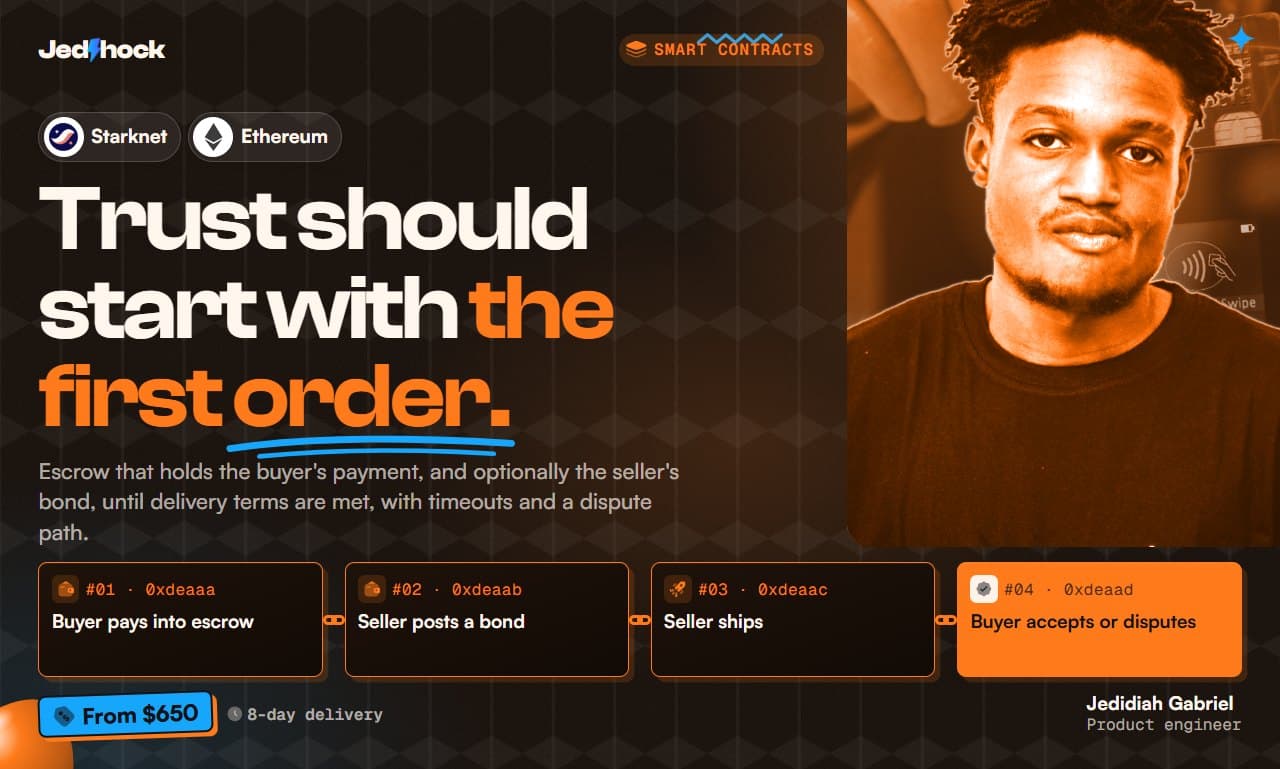
Smart Contracts
Marketplace Escrow Contract
I will build an escrow smart contract for your marketplace on Starknet or EVM
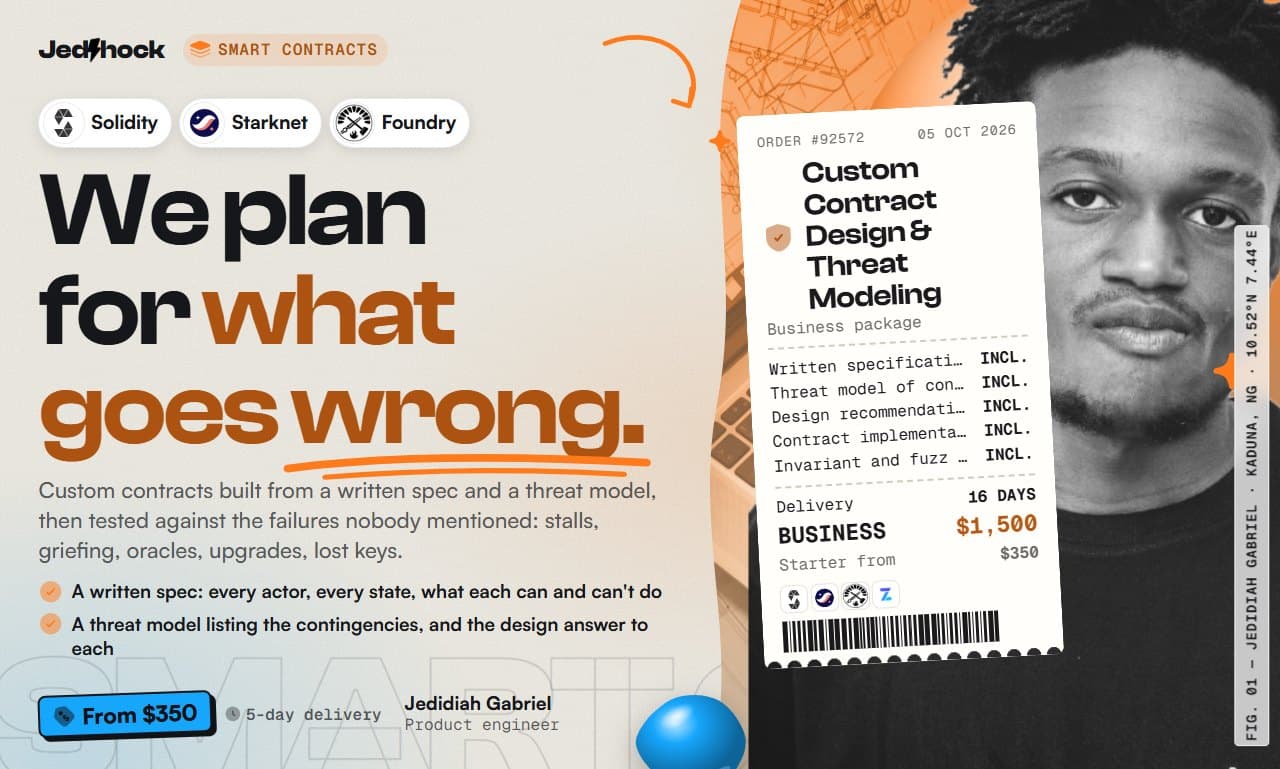
Smart Contracts
Custom Contract Design & Threat Modeling
I will design custom smart contracts with threat modeling and invariant tests